

AI overload is real. The list of buzzwords is considerable: adoption, implementation, agents, agentic workflows, tools, context, memory, ethics, data protection, and on and on it goes. The vocabulary alone is challenging to absorb and keeping up with the ever-evolving AI tech space is a job in itself.
But, one thing is for sure. Used intelligently and with a clear outcome in mind, AI is a powerful enabler and capacity building tool that can give back time, which can be directed to the relationship work that advancement professionals do best.
For the past few years, and especially since moving into the consultancy and business ownership space myself, I have been using AI for a multitude of strategic and tactical purposes. However, one key insight has surfaced and remained consistent throughout — Humans first, AI second. Without the human creativity, judgement and direction, the AI does not deliver on relevance or quality.
For this article I wanted to test my thinking with some leading advancement practitioners and so I was delighted when brilliant colleagues Phillip Stork, Vice President, Future Students and Strategic Communications, of Griffith University in Australia and Rachael Green, Head of Alumni Engagement – Faculties, of the University of Nottingham (UK), agreed to share some insights into how their teams are deploying AI in advancement in two different parts of the world, and in two different advancement contexts.
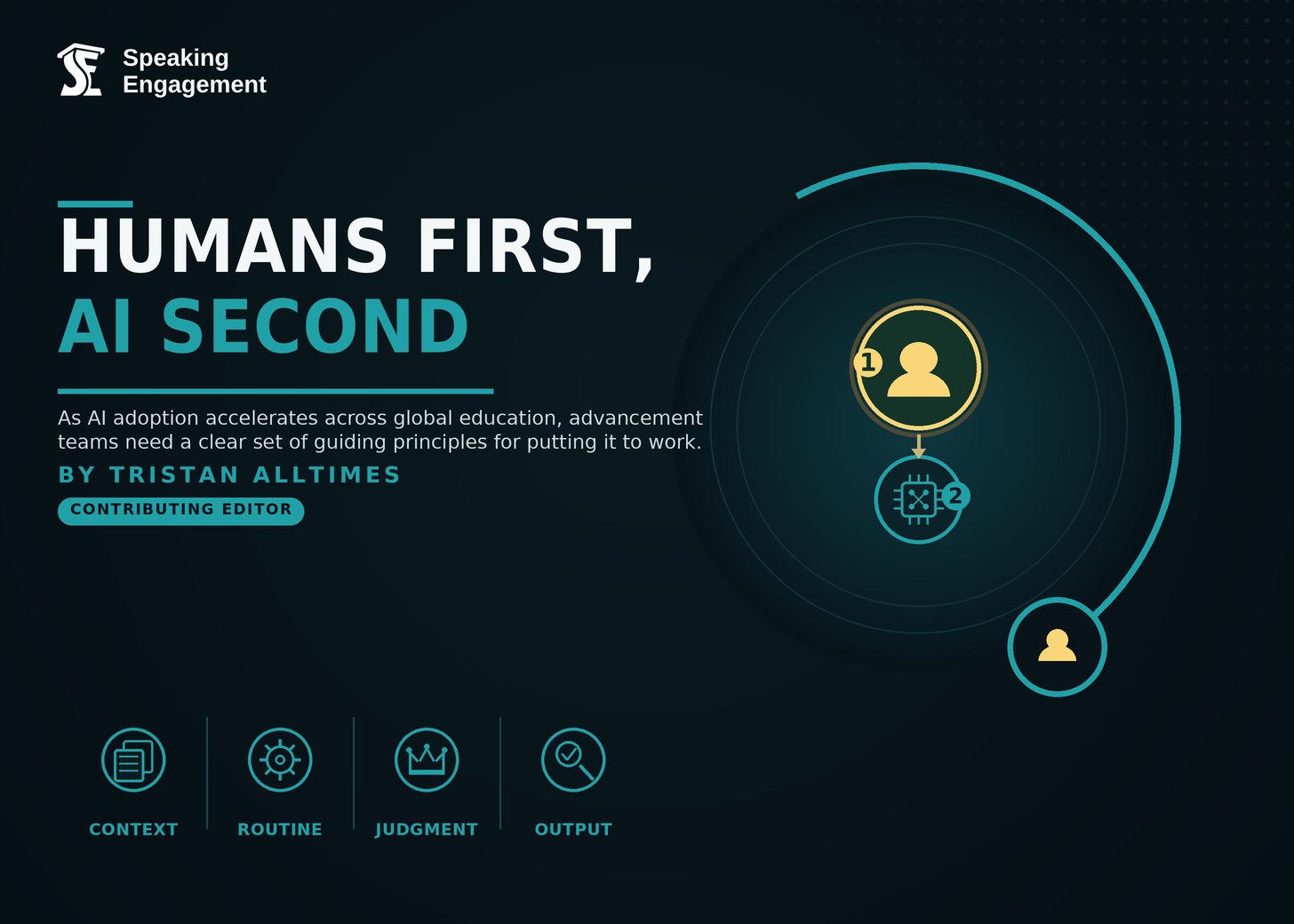
Four common habits surfaced, in all our respective work applications.
1. Comprehensive CONTEXT
At the outset of my AI journey I allowed my LLM tool to interview me to generate what was called a context library (thank you Allie K Miller for the idea). It took a good half day of feeding responses to its probing questions. My business goals, my career goals, my life outside of work, one question at a time. The result, a repository of documents that the LLM could always draw upon when responding to my prompts of the future. I went all in on sharing, trusting in the process that better context (input) would mean better output. I was right, it was substantially better after the process.
Since then I have continued to build on that context. Continuously feeding market research findings in, showing the AI what good looks like to me through real examples from the marketplace (and my previous work), emails I have written, documents I have written. The more context the better. The output has continued to strengthen and responses coming back have been more relevant, personal and impactful.
Rachael’s team started in the same place. They developed a handbook of guidance to support how they manage their alumni email inbox. That context was then used to train Microsoft Copilot. “Historically, this was a full-time role in itself, but by training Copilot on our guidance and processes we’ve significantly reduced the time spent drafting responses”.
Phillip says communicators need “a clear set of key messages and overarching narrative before they start letting AI loose”. Another clear example of the importance of providing context first.
Context is not a one-off instance. At the end of each working session, I ask the system to consolidate what it has learned, to update our business system memory, update any agents’ capabilities (skills) and capture any outstanding tasks to my master task list (for later retrieval and action). This means the next conversation starts from a considerably improved state over the last and the context is ever evolving (and improving).
2. Allocation of the ROUTINE work
Phillip uses AI where volume is high. “We are using it extensively to support tier zero and one enquiries in our Current and Future Student Contact Centres, taking existing content and tailoring it to student needs…. We have also developed copywriting agents to support our marketing managers to produce consistent and student centric content for our websites, study guides and other student publications.”
At Nottingham it drafts replies for the alumni inbox and helps prepare volunteer communications, event plans, promotional copy, FAQs and briefing documents.
In my consultancy business it checks my daily emails, triages by importance and updates my CRM accordingly, surfaces important items on my daily dashboard and hands off to relevant agents in my team for further assessment and action.
A common thread: high volume, repeatable work, guided by something written down. Rachael’s team has its inbox handbook, Phillip wants key messages and narrative in place first and I use Standard Operating Procedures or Playbooks, so the AI understands how we do things for the routine work.
3. HUMAN JUDGEMENT is king
Phillip is direct: “Keeping a human in the loop in any personalised content, data analysis or copywriting is critical.” Phillip and his team do not use AI to make decisions. For him it is a way “to expedite repeatable or exploratory work.”
Rachael’s team uses AI to identify themes and highlight evidence when more than a hundred students apply for alumni volunteering opportunities. “AI can help identify themes, summarise applications and highlight evidence against predetermined criteria. When supported by a clear scoring matrix, it can be particularly useful in managing large applicant pools, helping my team quickly identify relevant experience, motivations and skills while maintaining consistency.”
Even so, she goes on to add: “All assessment decisions, scoring, judgement calls and final recommendations remain the responsibility of people, who provide the context, interpretation and accountability that AI cannot.”
In my context, I think of AI as a thought partner. It can support me in thinking through many opportunities and challenges in all aspects of my business, but the final decision always sits with me, drawing upon my 30+ years of professional experience as the foundation for that human judgement.
4. Check the OUTPUT
Phillip has seen it make mistakes: “I’ve seen a few examples where the AI tool has analysed the first few hundred data sets and then started to make assumptions.” His test is to: “treat the AI like you would an intern”, asking how it approached the task and what limitations it found.
Rachael’s team sees the same thing: “information is often presented with more confidence than it deserves.” Most of their corrections are “less about factual errors and more about tone, context and organisational knowledge that only a person would have.” On the alumni inbox, “AI proposes answers and pulls together relevant information, but staff still review, amend and approve every reply before it is sent.”
I run my own work through the same sort of process. Before anything is used externally, I put it through an agent within my team responsible for reputation management. That agent checks anything external against my brand intelligence guidance and surfaces any risk for my judgement. I also have guardrails set up that determines which folders or files that each agent can access and/or save to, and I have turned off the setting that allows my conversations to be used to train the provider’s models.
A useful set of words to improve an output can also be inserted into your prompt towards the end of a production schedule on an asset (email, agreement, analysis, report, presentation, copy etc). A simple ask for it to do a ‘red team critique’ and ‘conduct a blind spot analysis’ ensures you have run a more robust process. This has identified both excellent opportunities I may have inadvertently not seen, plus, saved me from some easy to miss mistakes on occasion.
Closing thoughts for practitioners
I asked both Rachael and Phillip what a team starting out should try first. Phillip’s advice, noted earlier, was to have the key messages and narrative in place first. Rachael’s answer was practical, “I’d start with low-risk, high-volume administrative tasks such as basic customer service activity (drafting simple emails with templates, summarising documents, preparing meeting notes, creating first drafts of reports and answering easy enquiries). These are areas where the efficiency gains are immediate and the risk is relatively low.”
From my perspective, I would add that AI is not always the solution. A useful framework I picked up from the AI Fluency Framework & Foundations course from Anthropic earlier this year was the 4d framework, which is a useful model for the application of AI:
* Delegation – what are you trying to accomplish? What can we handle ourselves and where can AI help? Recognise what AI can do well and not. This is about strategically choosing how AI fits into the process.
* Description – clear communication with AI. It needs detail rich conversations. What are you hoping or trying to achieve from the output? How the AI approaches the task and the context it needs for how you want it to work with you and the tone and style for the communication.
* Discernment – Thoughtfully evaluating what AI gives you. Are facts accurate, does reasoning make sense, do the recommendations align with my brand values and audience? Dos the output help me move forward. Develop judgement on recognising when it is good or not, or set aside entirely.
* Diligence – responsible AI interactions. How are you ensuring fairness and controlling for bias in a process? How is it verifying data? How am I being transparent in the use of AI? How am I being accountable and having ownership with the work with AI?
Humans first, AI second
The buzzwords will keep evolving and the technology will keep moving, but the principles above will remain for the foreseeable. Give AI comprehensive context (and continuously build on it), allocate the routine work and keep the human judgement and quality control top of mind at all times. By following these four principles, you can strengthen your confidence and capability in the deployment of AI in advancement.
Phillip and Rachael’s closing remarks give some good insights into their thinking for the immediate and near future.
“Just as digital became a foundation for all marketers about 15 years ago, the careful and considered use of AI is a critical skill I look for when hiring any marketers”.
Rachael added: “We’re experimenting in areas where we feel comfortable, learning what works and what doesn’t, and gradually expanding from there.”
I would be interested to hear about your own experiences, learnings and insights in deploying AI in advancement contexts across the globe.

Tristan Alltimes is a contributing editor at Speaking Engagement and the Founder and Principal Consultant of Alltimes Advancement Consulting (AAC).

I appreciate a lot have concerns and rightly so but the power of the technology, yielded strategically and responsibly, has the capability to reduce administrative time - something you can direct back to that all important HUMAN relationship work. That’s one thing I think all advancement professionals will agree on Courtney - relationships are best managed by humans (with a little help from their AI friends where necessary and appropriate). Thanks for your comment.
Your emphasis on taking responsibility for AI’s output gives “human judgment” something concrete to mean.
The next question for me is what happens to the time we get back from the use of AI. Does a fundraiser call a donor they haven’t spoken with in six months, or does the organization simply produce more communication? Are we simply doing what we already do more efficiently, or is the actual output increasing on balance?
That responsibility also means seriously questioning what we review. Approval alone might not tell us much.