

Every July since I started consulting, I’ve attended the CASE Summit for Leaders in Advancement conference. I’m writing this from the lobby of the Westin Seattle after sessions are done for today but before dinner with friends and partners.
What I like most about CASE Summit is that people come eager to chat and exchange ideas. The conference represents a terrific opportunity, because it’s usually very well attended, to take the pulse of the advancement community and both see and hear how people are thinking about the current environment and the pathway forward.
FWIW. The vibe was much more positive this year than last. I remember thinking last year that everyone was in a dark place and the mood was somber for obvious reasons.
Advancement VP’s presented bold ideas
I attended two back-to-back sessions that I think help explain how vice presidents are feeling about engagement. In one particular session, John Morris from the University of Minnesota Foundation and Cutler Andrews of New Ideas gave a provocative session called The Realignment Imperative: Disrupting Advancement’s Status Quo.
Cutler Andrews was a last-minute, emergency fill-in for Joshua Newton, the SVP for Advancement and Alumni Engagement at Emory University, who had travel challenges. Cutler recently left his role at Emory as Chief Experience Officer reporting to Newton.
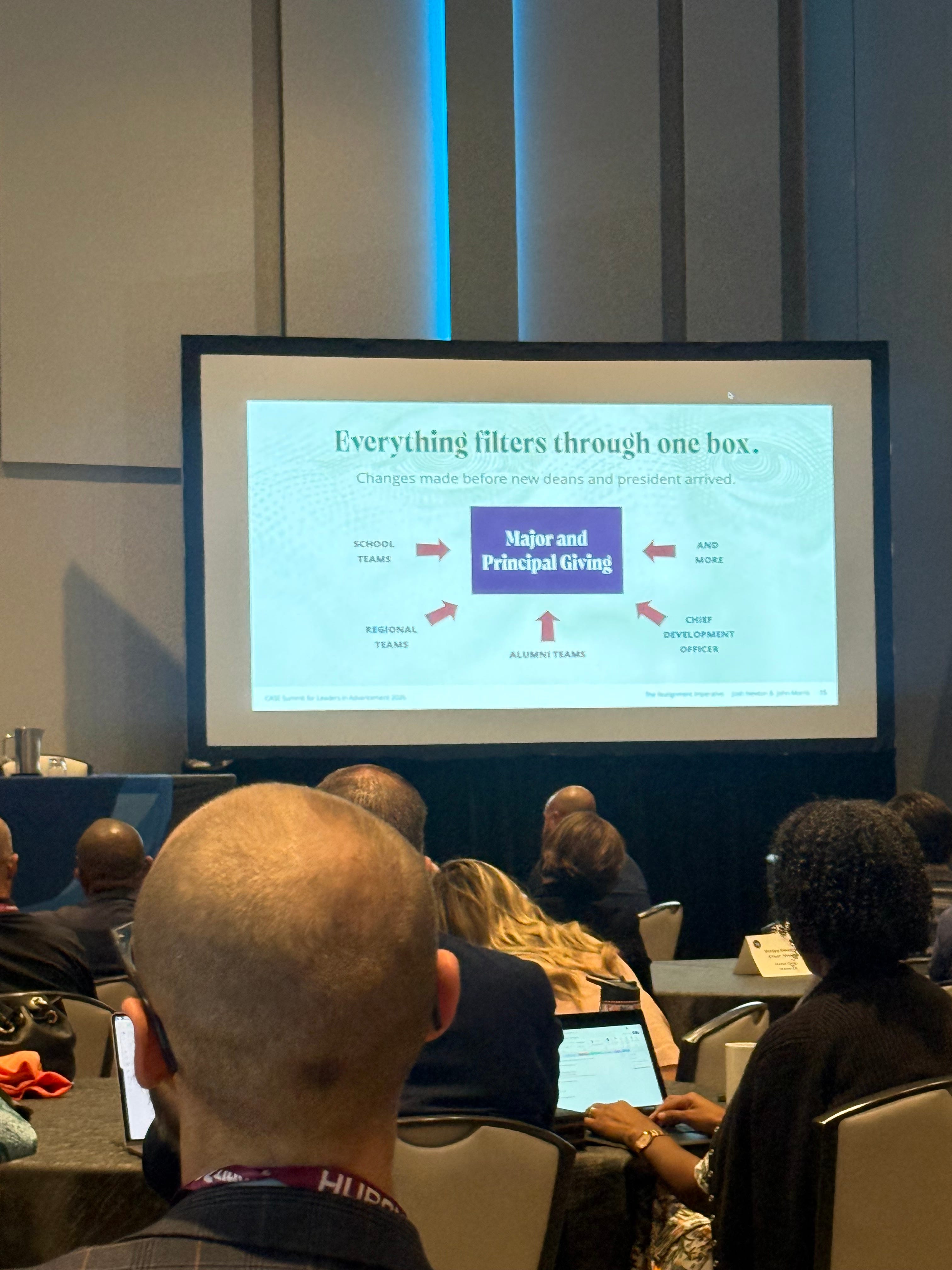
Morris and Andrews’ contention was that university leaders need to be honest that advancement is about raising money. That’s the mission, and 97% of dollars come from 3% of donors. So, if we’re really thinking about using scarce resources effectively, the vast majority should be allocated toward major gift pipeline cultivation. Everything else should be cut or automated.
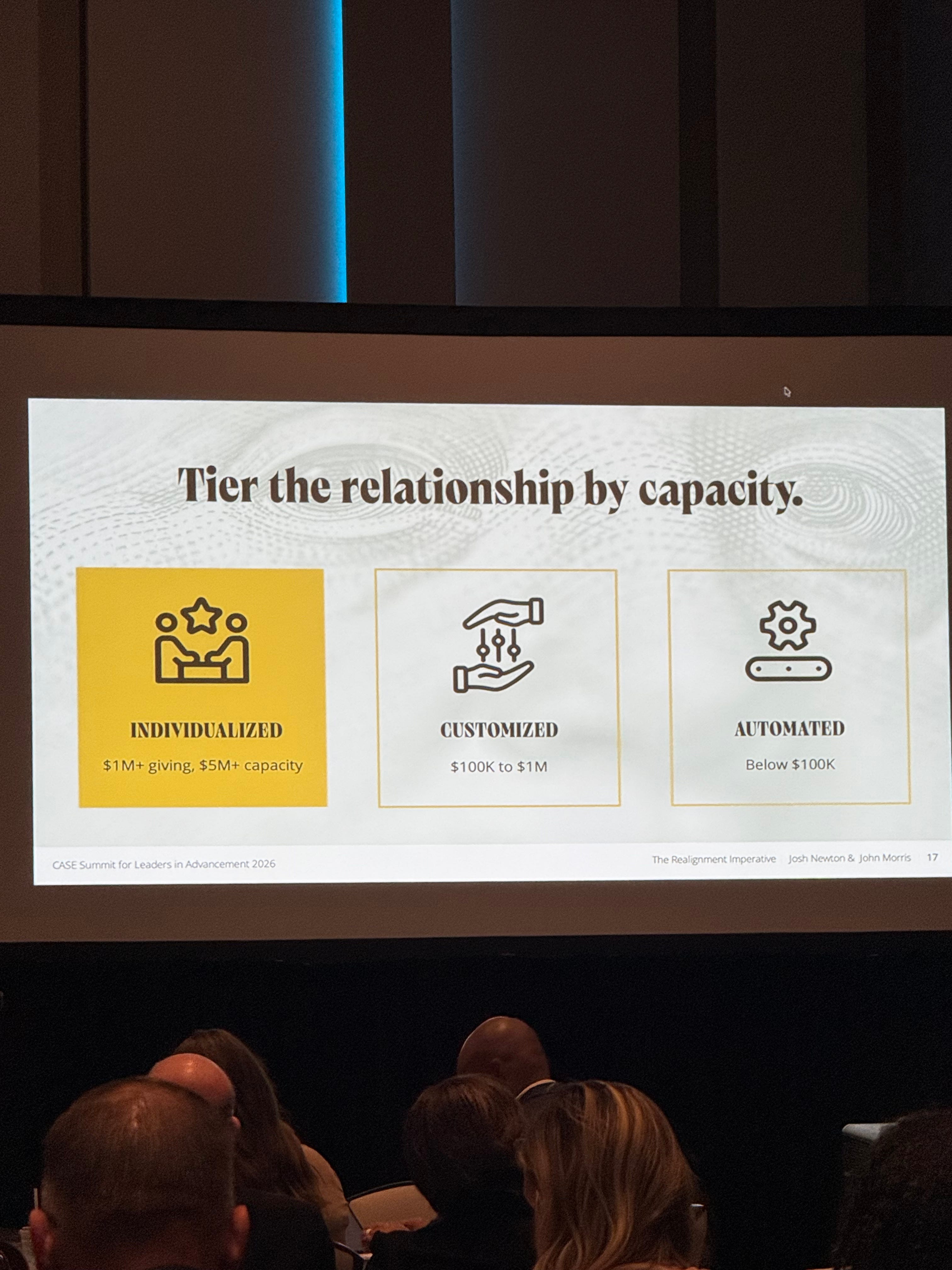
Their view is that automation should shape all donor engagement under the $100K gift capacity level. Obviously, every school is a bit different as far as that dollar amount, but the point was that there are way too many resources currently being allocated towards engagement efforts at the other end of the pipeline that aren’t closely enough tied to the major giving.
Engagement work that’s not major gift aligned is under evaluation
So to advance the thought experiment, what programs and activities are probably not closely enough aligned with major gift pipeline development? That’s a good question. My head went into the laundry list of items that one would probably have to cut when ranking whether they’re closely tied to major gift pipeline work.
I had the chance to speak with Cutler and asked him whether Advancement VP’s and engagement pros are on the same page about focus on the major gifts end of the pipeline versus everyone else. He was until recently the Chief Experience Officer at Emory, after all. He said,
“I do think we’re talking past each other at times. It’s not an either/or; it’s a yes-and. Ultimately, we all share the same goal: impactful, prosperous, sustainable universities, and sustainable universities. To achieve this, we need financial resources, but we also need an engaged and passionate constituency.”
I wanted to write about it because you all should know these discussions are happening to huge audiences of advancement leaders. These are the conversations shaping the field.
Alumni engagement professionals are having some of the same conversations we had a decade ago.
Following this presentation with Andrews and Morris, I attended another session called “Is Volunteerism Dead?” John Pine from UCSC and Tim Valentine from NYU described their session title as “click-bait.” Of course, slide 2 was the answer: “No, volunteerism is not dead. It’s changing.” Alumni, particularly more recent grads, want opportunities to volunteer that fit into their lives in short bursts.
Their take was that involving more alumni in volunteerism is important, but folks, particularly recent grads, want different, non-traditional roles.
We’ve been having this conversation for a long time now about scaling volunteerism and what “micro-volunteering” should look like. In fact, the last time I was in Seattle was as a faculty member at the CASE AEM conference in 2017, where we discussed this very subject. My point isn’t to criticize Pine and Valentine, because they were primarily working to lead a discussion and create an environment where attendees discussed in small groups and then shared what’s working for them.
I mention this because of the juxtaposition of these back-to-back sessions. On one hand, we have senior advancement leaders saying to themselves that the dollars are flowing from a small group of donors and we need to focus on them wholeheartedly, and perhaps, exclusively. The following session, engagement leaders are still just scratching the surface about the absolute necessity of tying donor engagement with volunteerism at scale and proving ROI around major gifts.
Coming out of the conference, my feeling is that engagement leaders need to be eyes-wide-open about how leaders are thinking about the work and advance the ball accordingly.
About Speaking Engagement
We just launched our Faculty-in-Residence with Mallory Erickson — a six-week “residency” where we explore the themes and research in her book What the Fundraising. Members should find out more and register for the live Symposium in September.
About the next Keynote
Coming up on Monday, one of my closest friends in the business. Max Leisten is the Founder & CEO of Protopia. He’ll be my special guest on the Keynote. We’ll discuss the challenges of integrating engagement technology right now.


