

Closing Remarks on a Great Week
A few months ago, I wrote an article on LinkedIn called “If I were building Advancement Engagement from scratch.” I got quite a bit of outreach about it, because it argues for an entirely new organizational structure for advancement engagement. The conversations I’ve had since have convinced me, more than ever, that this is the direction most leaders should take — particularly those in the run-up to the public phase of a campaign when it’s crucial to develop approaches for both depth and breadth of engagement.
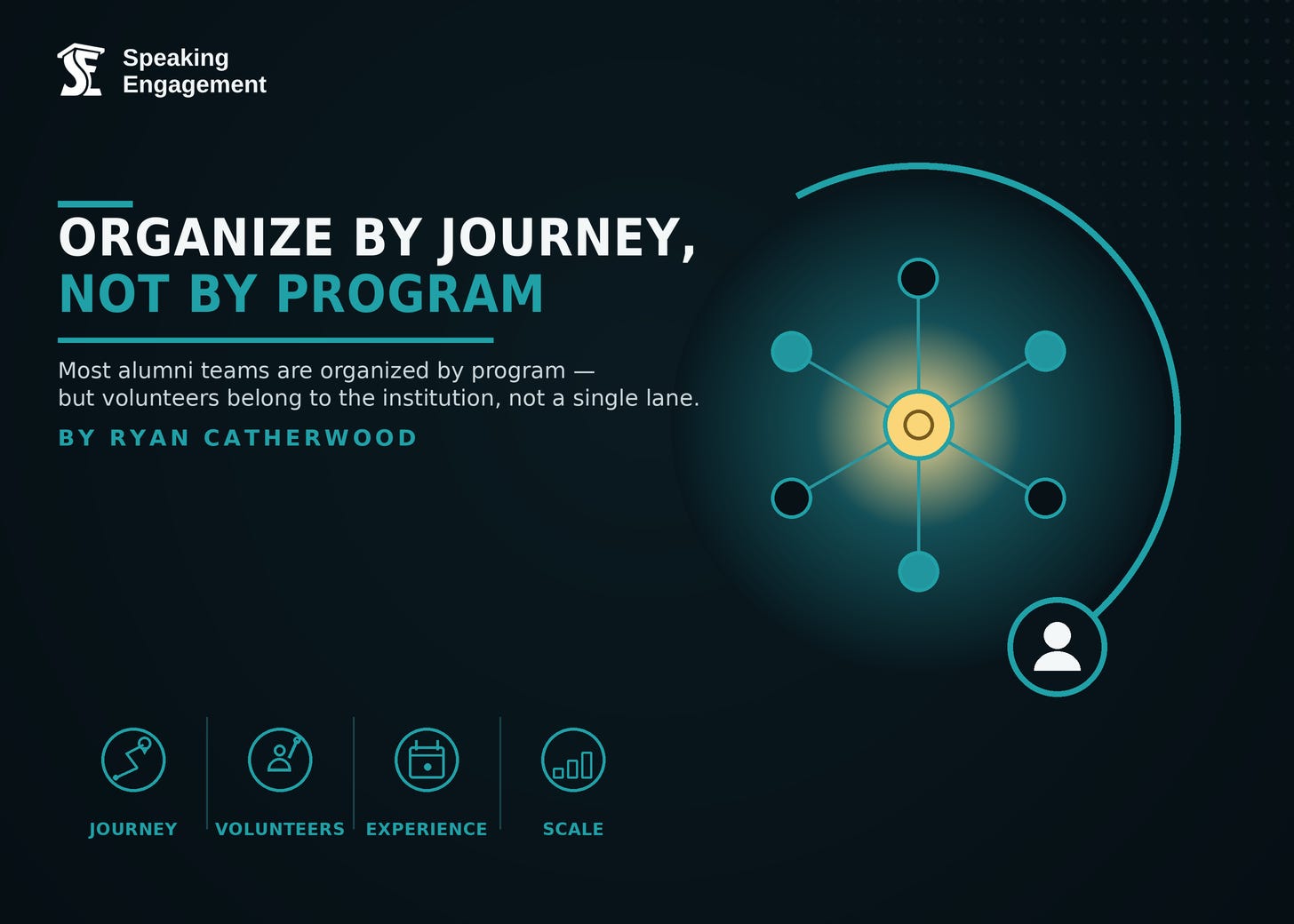
In that article, I advocate reorganizing teams by journey rather than by program. The most difficult part of this shift is also the part to tackle first: building cohesion between two teams that, in a journey model, have to operate as partners — a Volunteer Engagement team and an Experiential team. The Volunteer team owns the people: sourcing, placing, and stewarding alumni contributors, and tracking their involvement over time. The Experiential team leads the experience: designing and delivering the events those volunteers show up for and help facilitate.
A volunteer team should also lead engagement tracking and make sure volunteers actually succeed in their roles. And “success” is usually where the friction starts — because in a model where programs are the alignment structure, directors get territorial about “their volunteers.”
To see why, look at how most alumni teams are built today. They’re organized to build and execute programs: traditions like Homecoming and Reunions, chapters and clubs, career-based initiatives, and programming for young alumni and students. Each program team owns everything in its lane — communications, recruiting and stewarding its own volunteers, planning and running events, and looping in annual giving when it makes sense. Over time, that creates a structure where volunteers are tied to a specific program rather than to the institution and its broader priorities.
In a journey-based alignment, that structure shifts. Take chapters and affinity groups. The Volunteer team would recruit, onboard, and steward the regional and affinity leaders, track their participation, and look for ways to re-engage them in other roles down the road. The Experiential team member would work alongside those same volunteers to plan the event calendar, shape the experience, and handle logistics. Both colleagues are working on the same chapter or the same affinity program — but with clearly defined roles: one focused on the people and their ongoing involvement, the other on the experience being delivered. They’re partners across teams, with different vertical reporting lines.
It's also a real development opportunity for your team: organizing around journeys means putting people in roles that play to their strengths, not just whatever their program happened to need.
So what does a volunteer engagement team actually do? I’d give it four jobs: catalog and map the volunteer opportunities that already exist, create and manage new programs designed to scale, ensure the engagement is high-quality for both the school and the volunteer leaders, and own the data and reporting for volunteerism across campus.
That first job — cataloging — is bigger than it sounds. On every campus, volunteerism is already happening in silos and pockets outside of advancement. There are school- and department-based advisory boards. Coaches in athletics pull in alumni throughout the year. A handful of faculty, especially in business and engineering, bring alumni in as classroom speakers. Career services keeps a list of alumni who help with mock interviews. To build a journey-based approach, all (or most) of these need to be cataloged and folded into an institution-wide strategy.
Done well, and with a lot of coordination, the idea is that an interplay develops over time between the central volunteer team and the rest of campus, as new volunteers are placed and those who’ve finished a role are intentionally brought back for another.
The team should also stand up and lead pan-university programs of its own — ones where alumni can offer advice, reflections, and, now and then, congratulations to students at key moments in their journey. And one of the most valuable things a central team can do is bring more alumni donors into volunteer roles, not just the usual volunteer pool.
A centrally coordinated volunteer function lets an institution move past episodic engagement into something steadier and more intentional. Volunteers who show up for one initiative can be re-engaged in the next. Alumni who raise their hand once can be guided into deeper involvement over time. And the people already giving can be brought into volunteer roles that reinforce the connection they already have.
A journeys-based approach and alignment allows for the scaling of volunteerism and a focus on engagement retention.
None of this is easy, and that's exactly why it's worth doing. The hard part isn't the org chart — it's asking people to give up a kind of ownership they've held for years and trust a new way of working that doesn't have a playbook yet. But the institutions that figure this out won't just run better programs. They'll build relationships with alumni that outlast any single event, director, or campaign.
Discussion: What do you think would be the hardest part about standing up this new model at your organization?
About Speaking Engagement
I’ve been wondering how subscribers and members are feeling about the volume of content they’re receiving. Mind answering a one question survey?
About the next Keynote
If this has you rethinking how we organize teams around people, Monday's Keynote takes on the leadership side of that same question: I'm joined by Shanna Hocking — author of One Bold Move a Day and founder of Hocking Leadership. New episode drops Monday on LinkedIn, YouTube, here on Substack, and on your favorite podcast app.