

One of the most challenging dynamics to manage on an on-going basis, particularly for medium- and large-sized institutions, is coordinating the central advancement unit with the colleges and schools. The relationship is often disorganized and can even become adversarial because deans and advancement leaders across eras have failed to build a synchronized engagement strategy. It’s like a pendulum slowly swinging between centralized and decentralized approaches.
Defining best practices for leading a fully coordinated, campus-wide approach to stakeholder engagement and external relations is often a topic in my consulting conversations with partners. After five years of client work with universities on this challenge, I believe there’s a clear framework all colleges and universities should pursue.
Introducing the 70/30 model
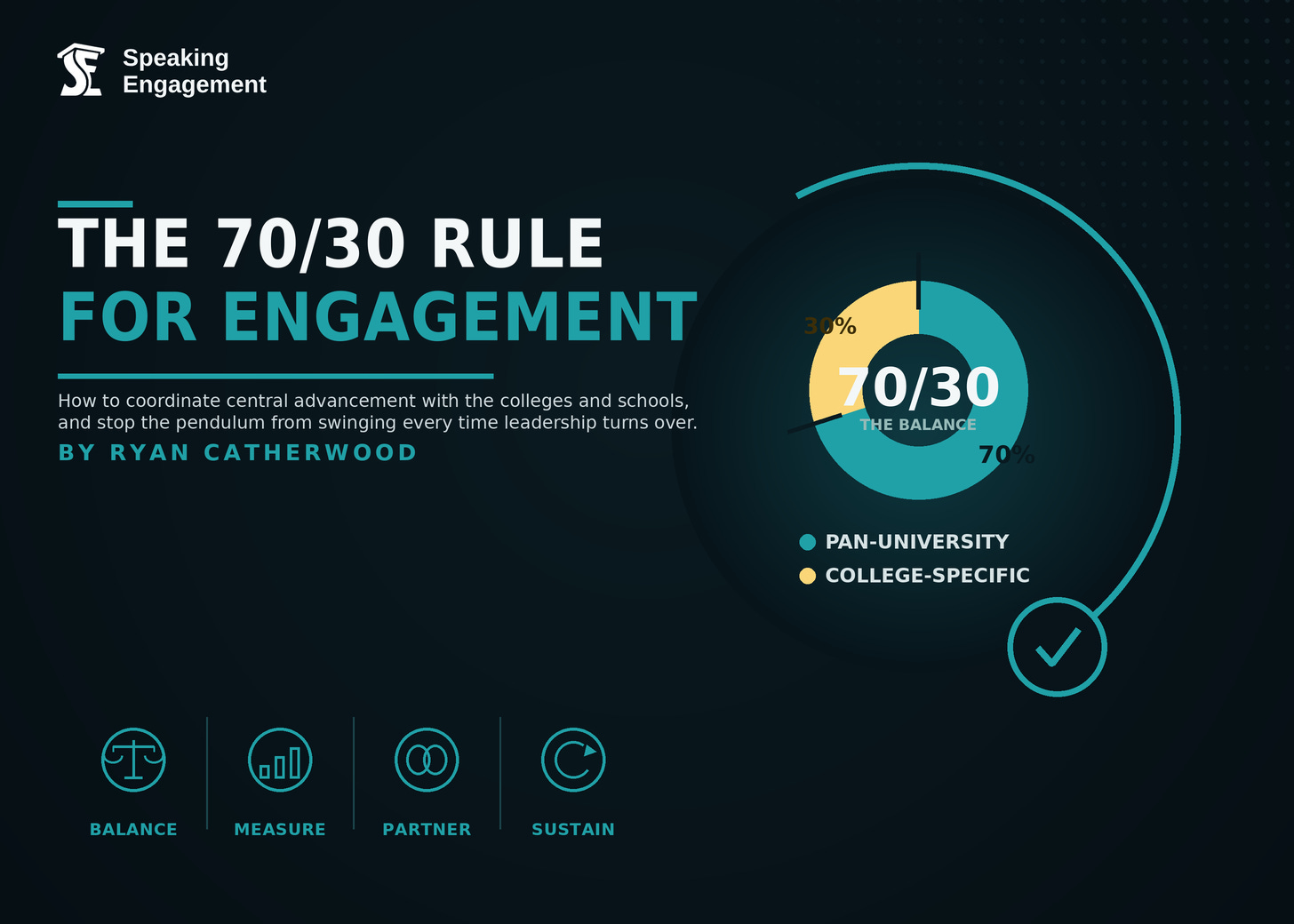
University advancement offices work to develop engagement events, programs, and volunteer initiatives. Most of these are pan-university initiatives, and stakeholders across the institution routinely participate. Think reunions, giving days, crowdfunding, homecoming, regional engagement, and digital engagement, including various technology platforms. I feel that 70% of engagement at any institution should happen through these initiatives.
Academic deans should first consider how they’re promoting and using these opportunities as the focal point of their engagement strategies, ideally before developing any separate and distinct initiatives. College- or school-based engagement can be layered on top of a pan-university initiative.
At the same time, 30% of engagement should be college- or school-specific, and contain the unique characteristics and personality traits of those entities. There is a need for individual colleges to build and execute their own engagement strategies. College deans and faculty build special relationships with their stakeholders, and many alumni meet lifelong friends through their academic coursework.
When metrics are missing
One of the most common dynamics I help schools work through is that, because central advancement hasn’t built a system to track engagement and report on engagement, develop a scoring methodology, and set measurable goals, a knowledge gap creates mistrust.
Every centrally-led engagement initiative attracts alumni with degrees from across the university. It happens every day; advancement engages graduates from colleges, schools, and faculties (if you’re in the UK or Australia). The problem is a lack of reporting. There’s no scorecard. There’s no hot list report of activated donors containing evidence that university advancement is providing this key service already.
That’s when academic deans throw up their hands and chart their own course.
What academic deans want isn’t control over engagement programs; it’s proof that what advancement is doing is working.
Staffing should support the 70/30 model
The first step in creating a stronger partnership between advancement and the colleges, schools, and units on any campus is to come together for strategic planning, then develop a top-notch approach to metrics and analytics. Facilitating buy-in and ongoing collaboration requires these two steps.
After that, the trick is to figure out how to staff the model. I struggle with the “college engagement officer” concept. It’ll be the subject of a future newsletter, but assigning an individual, often at an entry-level career stage, to coordinate this model, which ultimately must increase trust between senior campus leaders, seems like a tall ask. These positions change over constantly, and they position early-career engagement professionals as liaisons who must also be capable event producers, volunteer managers, and experienced communicators.
Senior leaders need to stop the pendulum and work together
The biggest hindrance to building a successful, coordinated, campus-wide engagement program is the lack of a plan, missing metrics, and senior leaders often handing relationship-building off to early-career colleagues.
A junior colleague can coordinate logistics, but they can’t really build trust between a dean and a vice president or even AVP-level leaders, and it isn’t fair to ask them to. Stopping the pendulum is senior leaders’ work, and it’s ongoing.
But it’s hard to overstate how important metrics are. Academic leaders build careers on research, which must be quantifiable. When engagement pros can’t provide evidence that their approaches increase participation, everything breaks down, and trust erodes. Success begins when academic deans can hold, or receive in their inbox, regular updates on stakeholder engagement and insights into how and with whom they should spend time.
The institutions that get this right treat the 70/30 model as a shared commitment, not a split to relitigate every time leadership turns over. They agree on the balance, govern to it, and let the analytics light the way. That is how what is sometimes a fractious relationship becomes one that picks up steam and starts getting wins chalked up.
As always, I’d love your comments!
About Speaking Engagement
We crossed the 500 subscriber mark this week! I’m really proud of how far SE has come over the last few months. I continue to receive positive feedback. It’s been a grind at times, but when I hear from folks that they find this resource valuable, that makes it all worth while.
To celebrate this milestone, I’d offering the opportunity for each member to gift one free six-month membership to a friend or colleague.
Refer a friend promo is through Nov. 6th, with free access ending April 30, 2027
Step 1: Ask a colleague at another institution if they’d like free members access to Speaking Engagement through April 30, 2027. Feel free to send a link to this info sheet.
Step 2: Once you get confirmation they are interested in a free six-month membership, send them this form to fill out.
I’ll batch upload all referees to Substack on Friday, Nov. 6th and will confirm access.
About the Next Keynote
I try to bring lots of different opinions and angles to Speaking Engagement. On the Keynote pod I’ll be sharing on Monday, my special guest is Rich Korczyk, Chief Experience Officer at DeVry University. DeVry is an almost 100 years old and they’ve been helping adult learners reach their professional goals for a very long time. Rich is a true expert in engagement and experience design. I know you’ll enjoy this convo. Tune in!