

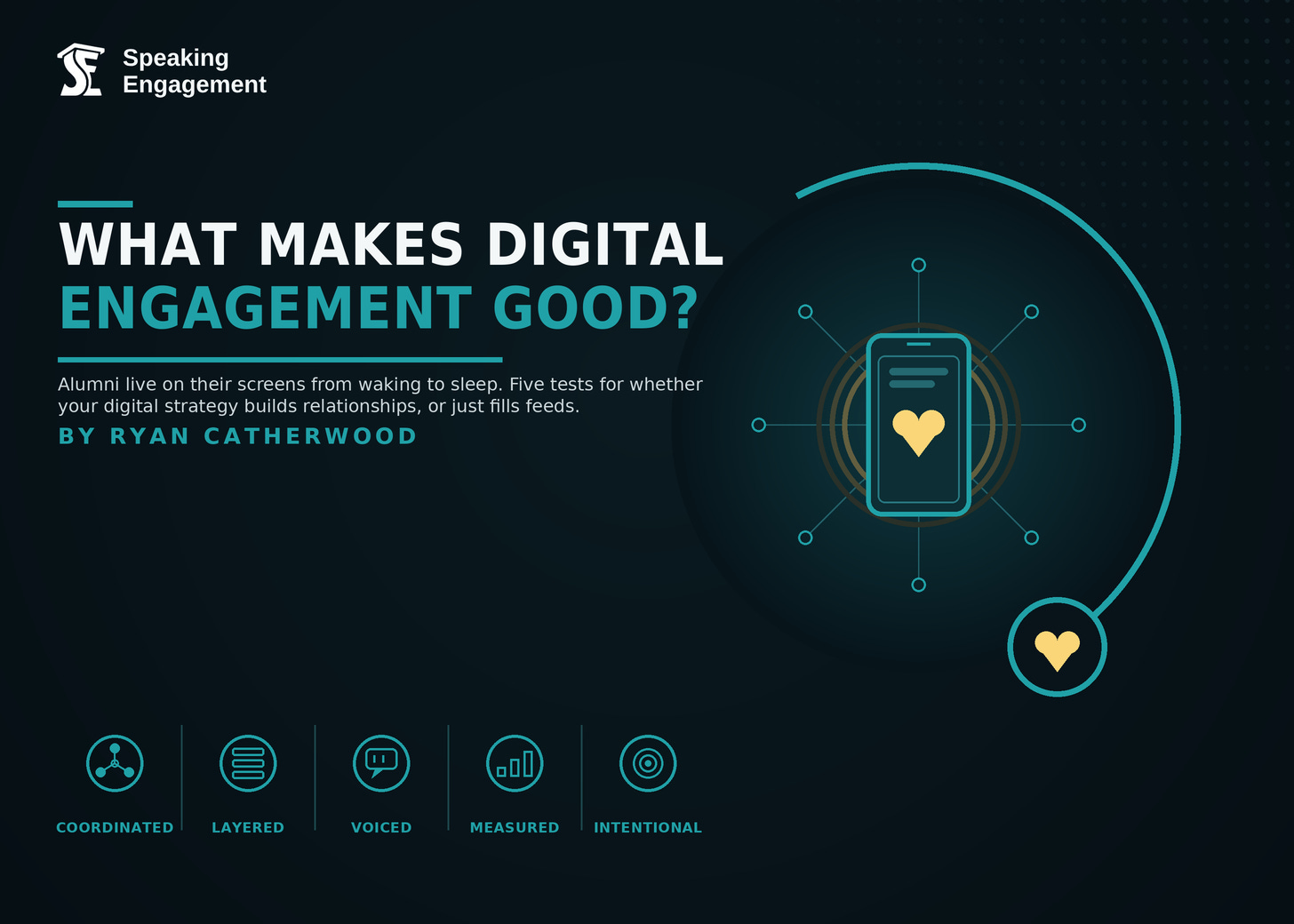
How can advancement leaders assess whether their approach to digital engagement is good?
I recently hosted a Washburn McGoldrick client roundtable on the topic, so this question is fresh in my mind, and I think there’s not nearly enough discussion more broadly about digital, despite it being literally the fabric of our lives. For some reason, digital engagement tends to take a back seat to in-person experiences in our field, even though, on average, people pick up their phones 180-200 times per day and spend as much as 4.5 hours or more on them.
That’s incredible, isn’t it? The fact that most advancement teams think of digital as some sort of specialized communications construct, instead of starting with digital and working outwards towards a few in-person experiences per year, flies in the face of how humans actually behave in 2026. Of course, screen time varies wildly by job, but in the U.S., estimates range from 6.5 to 12.5 hours per day.
So, day after day, week after week, alumni and donors are on their phones, tablets, and laptops from the moment they wake until they go to sleep, and most advancement teams are focused elsewhere. In many ways, our advancement teams still function like they did before we had smartphones.
So, if an advancement leader wanted to flip the script and say, “The first and most important thing we do every day is ensure we’re executing the best possible strategy to reach alumni, parents, and donors on their screens in the most effective ways imaginable to generate philanthropy and investment, what would that look like?”
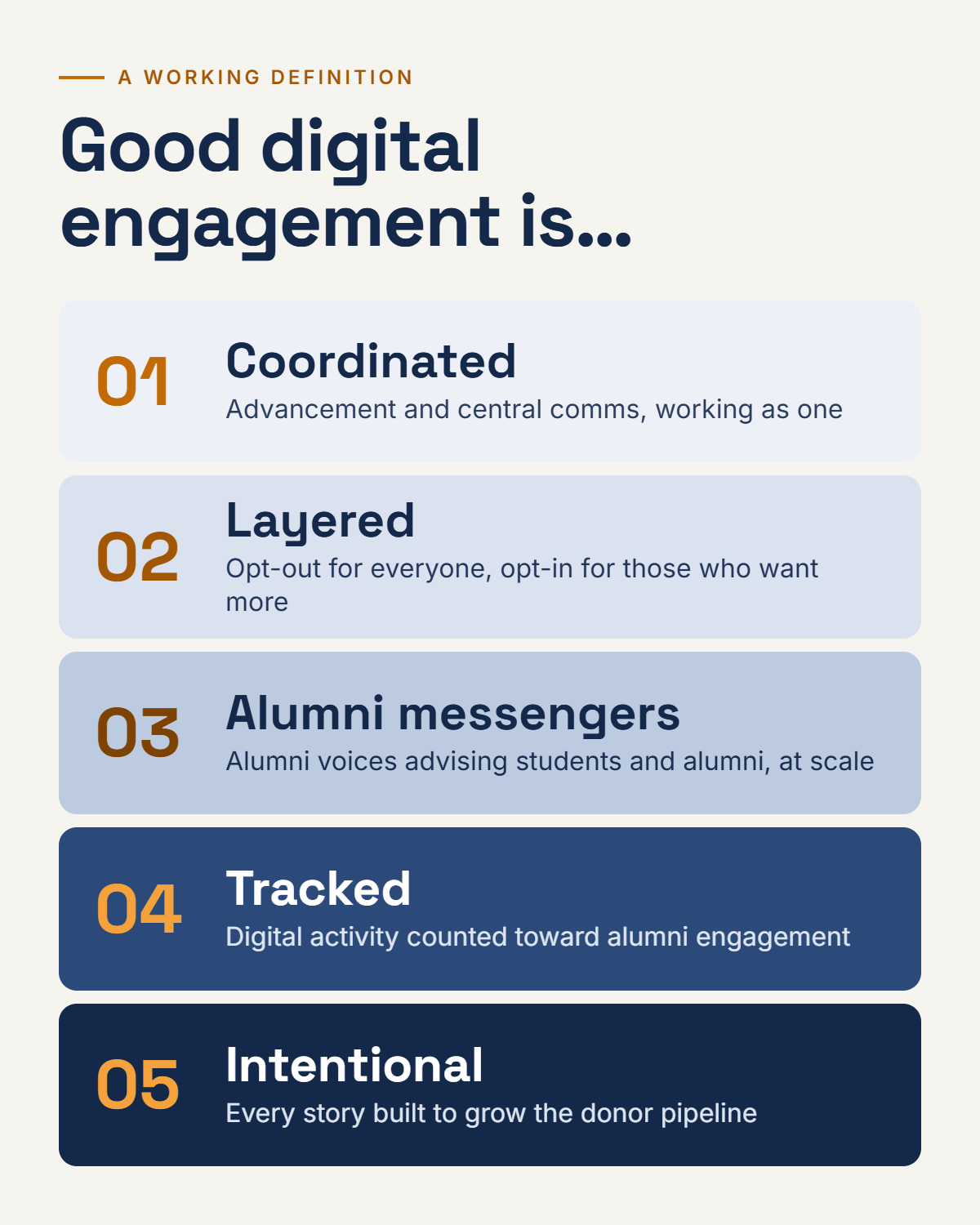
Coordinated across campus
One way to tell whether a digital advancement engagement is good is by how well it’s coordinated with other communicators on campus, especially the school’s main marketing and communications office.
If alumni-facing accounts managed by advancement communications are wholly uncoordinated with the main social media accounts every day of the year except in the run-up to and on the day of major campus events, then it’s not very good.
If the alumni magazine doesn’t have a digital conversion to get people to sign up for a volunteer initiative or upcoming event, then the school’s approach lacks coordination and isn’t maximizing the potential impact.
Colleges and universities that bring together communication strategists from across the institution in a community of practice to strengthen the institution’s collective storytelling and engagement enterprise will have an immense leg up in facilitating deeper involvement. Advancement leaders should bang the drum of coordination first and foremost, including shared goals, because everything runs downstream from there.
Layered, with room for hand-raisers
Good digital engagement gives people a choice about how much they want. Once an alum thinks to themselves, “I want more,” the school needs to have the next layer of involvement ready. We need to identify not just those who don’t want to hear from us, but also those who want to hear from us more often.
We need alumni to raise their hands. Donors need something to do between asks, but most of the time, colleges and universities have only an opt-out layer for communications, and an opt-in layer for experiences.
The key is having both strategies ready, so alumni and donors can turn up and down the dial and create a more personalized experience.
Told in alumni and donor voices
Any effective digital advancement engagement strategy today will include stories told by community members, for two main reasons. First, community-generated content is more authentic, and people tend to take more action as a result. It’s the same reason that peer-to-peer fundraising is so effective.
Digital engagement strategies that harness community-generated content are often present during giving days or other signature initiatives, but absent for the rest of the year.
The second reason to focus on co-creation with alumni is to provide volunteer and freelance opportunities at scale throughout the year. We want to provide alumni with a means to make an impact. Alumni-supplied advice and reflections, as a strategy to scale engagement, are important and need careful consideration. If we ask alumni for content, we need to make sure we can use it.
Measured, consistently
It’s not possible to measure every like on social media, so what can we measure? Colleges need to determine what they can measure consistently and track as part of their approach to producing alumni engagement metrics. Someone needs to own this as part of their work.
One interesting example of being thoughtful and consistent about measuring is that schools will often have forms for alumni to update their contact details. These forms are handled by advancement services teams. However, the act of updating the form is measurable digital engagement and should be counted as such.
What schools select to track and measure can look different at each institution. The most important part is consistency.
Intentional about generosity
The purpose of the advancement unit is to stimulate generosity and investment. The point is not to track activity or even to propel event attendance. Our objective is to generate more gifts of time and treasure.
We also need to create a feeling of warmth, fun, excitement, and positivity to stimulate generosity. Not every digital engagement strategy is an ask. Sometimes it’s just a hello and congrats. It’s a digital high five for a job promotion. We need to utilize our digital resources to create memorable moments that surprise and delight our stakeholders.
That said, everything must connect to developing a donor journey that keeps participation in the life of the university on-going among those who love the school most.
When all of these components are present, digital advancement engagement is great.
If our stakeholders live on their screens, and we spend most of our time planning and executing engagement for when they’re not on their screens, we’ve missed the boat. We are missing the boat. All of this requires a new posture from advancement leaders, whereby we think of digital as a daily front door to generosity. Teams that treat digital as a construct to coordinate, layer, co-create, measure, and ensure it’s intentional will capture and keep donors’ attention and become an everyday presence.
What do you think?
About Speaking Engagement
We’re been at it for 30 weeks straight, so next week we’re taking the week off and going dark for the Thanksgiving break.
You need the time to not think about work, too!
About the Next Keynote
When we return on November 30th, I’ll be sharing my conversation with Kelvin Bentley. Kelvin is the Director, Community of Practice on Microcredentials at the National Association of Higher Education Systems (NASH). I learned a shit ton during this conversation about how colleges and even full university systems are thinking about adding skills-based learning to the curriculum. Be sure to catch the convo after the break.
I love the line about “surprise and delight.” It has always been a joy to do so for individuals in my portfolio but then I become overwhelmed about how to do this for 1,000’s of people and still maintain that same authenticity.