

By Dr. Jay Dillon, Chief Alumni Officer, UC Berkeley and Founder & Principal of Alumni Identity™
My first job in advancement was making phone calls. While a graduate student at UCLA, I was hired by the alumni association to call every new and renewing member – not to solicit donations, just to say thank you and ask if there was anything we could do for them. I made 19,000 of those calls in one year.
Same script, every night. Wildly different responses. Some alumni lit up and talked about UCLA for half an hour. Others couldn’t get off the phone fast enough, even after I said I wasn’t asking for money.
I had their alumni records on the screen in front of me: class year, major, address, student activities, event attendance, giving history. None of it told me what kind of call I was about to have. I learned that the hard way. For a while I opened calls with comments about football or basketball, since UCLA is a huge sports school. Then I noticed that the engineer I’d never have pegged as a fan would talk about the game for twenty minutes, and the former student-athlete couldn’t care less. Eventually I dropped sports from the script entirely.
It took me years to understand what I was hearing on those calls. I was listening to alumni tell me who they are – they were describing their alumni identity.
The question underneath the question
Our field has spent decades asking why some alumni give and others don’t. Mostly we’ve answered it with engagement. The logic is familiar: get alumni to attend, open, click, and volunteer, and giving will follow. It’s the model most of our org charts, budgets, and dashboards are built around.
And engagement data matters. It tells us what alumni are doing, and without it we’d be flying blind. But it can’t tell us why they’re doing it. Participation is itself a choice that needs an explanation. So the question I’ve spent my career on sits further upstream: why do alumni engage in the first place?
Identity comes first
Alumni identity is the degree to which being a graduate of your alma mater is part of who you are today. That’s what I heard in those phone calls and later developed into the Alumni Identity Score™ as part of my doctoral research. Alumni identity isn’t pride in the logo or nostalgia for the quad. You can wear the sweatshirt every Saturday and never think of yourself as someone who shows up for your school. Affinity is something alumni have and can lose. Identity is who they are.
When identity is high, the difference in behavior is striking. Over the last decade, I’ve conducted Alumni Identity Assessments™ at eleven institutions. At the ten where we could match survey responses to giving records, alumni in the top third of identity were more likely to have given at every single school. At seven of the ten institutions, the typical low-identity alum had never given a dollar. At nine of the ten, the typical high-identity alum had. In total dollars, the gap is wider still: median lifetime giving across all ten institutions combined is $455 for high-identity alumni vs. $17 for low-identity alumni.
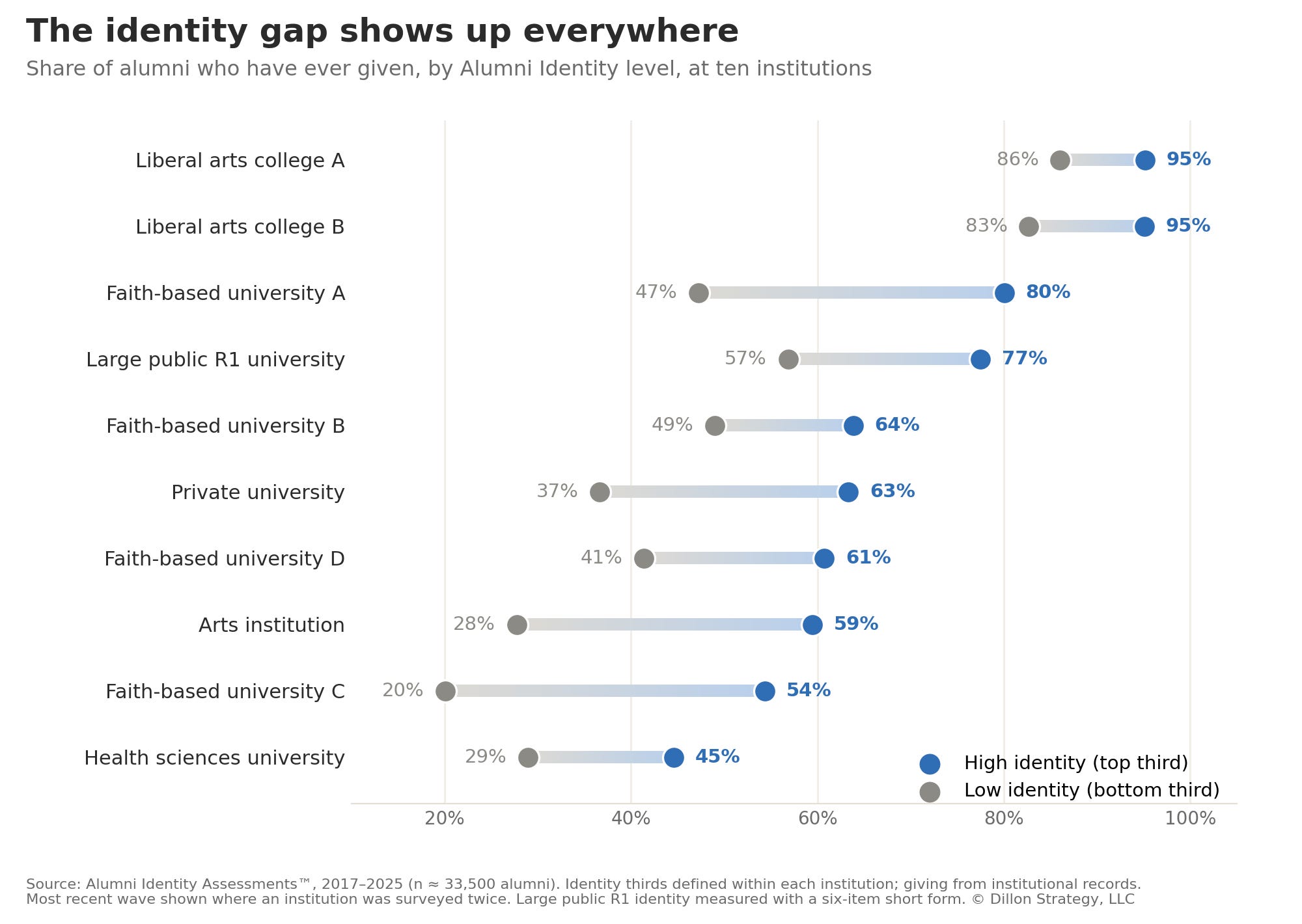
That pattern shows up at small liberal arts colleges and at a large public research university. Identity isn’t a luxury of elite schools. Everywhere we’ve measured it, higher identity goes hand in hand with higher giving.
Then and now
In 2018 I published an ebook with Salesforce.org arguing that three widely held assumptions in alumni relations were myths: that connection grows with age, that it follows class year, and that it depends on how close alumni live to campus. My evidence came from one university and about 4,000 alumni.
Eight years later, I’ve measured alumni identity at more than ten institutions: liberal arts colleges, faith-based universities, large and regional publics, a health sciences university, and an arts institution. Across tens of thousands of alumni, the myths are still myths. Age barely registers. Distance barely registers. The one demographic that consistently matters is family: alumni with relatives who also attended tend to have stronger identity.
I also got something wrong. In that same ebook I encouraged advancement practitioners to “say yes to social,” because in my first study, digital interactions ranked among the strongest correlates of identity. With far more data, that doesn’t hold. In the current dataset, about four in five alumni open their alma mater’s alumni e-newsletter, but opening it barely relates to identity or giving.
That’s what happens when you keep measuring: some of your ideas survive and some don’t. What’s held up? That alumni identity (the why) is upstream of alumni engagement and philanthropic behavior (the what).
Who builds identity
If identity comes first, the next question is: where does alumni identity come from. The uncomfortable answer is that most of the time it doesn’t come from advancement or alumni engagement/alumni association teams at all.
Years ago at an alumni event, I asked a graduate about his time at UCLA. He didn’t talk about a professor or a game. He told me about his freshman year in a triple with a difficult roommate, and an RA who didn’t help. Decades later, that was the story he chose to tell the alumni office.
Identity is built by residence life, faculty, advisors, coaches, and every office a student walks into. Ryan put it perfectly in our conversation: advancement can bring the blanket, but it can’t tuck in the bed by itself. By the time alumni reach our databases, much of their identity is already set. Our job is to recognize it and give it somewhere to go. Read that again. Advancement rarely builds alumni identity from scratch. Our job is to recognize it, activate it, and give alumni meaningful ways to express it.
A model for what’s upstream
I’ve spent the past few years turning this into a formal framework. This November 2026, Philanthropy & Education will publish my research note introducing the Identity-First Model of Alumni Philanthropic Behavior. The core idea is simple: identity leads to engagement, engagement leads to giving, and giving strengthens identity in turn. Engagement isn’t the engine. It’s how identity expresses itself.
If that’s true, then the most valuable thing you can know about an alum isn’t what they did last year. It’s who they are now.
One thing to try on Monday
So what’s next? What can you do now?
First, take a look at the survey you send after your next event. It probably asks how satisfied attendees were. Add two questions*, in this order:
Being an alum of [institution] is an important part of who I am.
Response scale from Strongly disagree to Strongly agree.Did your connection to [institution] increase, decrease, or stay the same as a result of this experience?
Responses options are Increase, Stay the Same, or Decrease.
Satisfaction tells you whether people enjoyed themselves. Taken together as a composite, response to these two new questions tells you whether you reached who alumni are. And keep in mind, an alum who agrees with the first statement in and reports their connection stayed the same after the experience – that’s a win.
Next time I’ll take on the harder implication, the one I called the most controversial thing I said on the Keynote: if identity comes first, we should learn to lose some alumni early.
*Feel free to use these questions. If you do, I’d love to hear what you find — reach me at jay@alumniidentity.com. The full Alumni Identity Assessment™ and Alumni Identity Score™ are proprietary to Dillon Strategy, LLC.