

Whenever I read somewhere or see on LinkedIn that an alumni association has created its own strategic plan, I cringe. If the plan was created by and for the association, then it’s a document with very little value, even though considerable work likely went into creating it.
There’s a better pathway forward for all alumni associations to create a strategic plan that everyone can rally around.
There are really three types of alumni associations. The first is fully independent. There are a very small number of these left in the U.S., where the association brings in revenue, covers all or most of its operating costs, and employs its own staff. Another organization type can be classified as interdependent, which is when a separate 501(c)(3) non-profit alumni association exists and brings in money through various royalty agreements, but the school employs all the staff. There are varying degrees of interdependence. A third type is the alumni association in-name-only. There’s no separate 501(c)(3) organization, but the university’s advancement office has elected to brand all alumni-facing programs as coming from an alumni association.
None of these alumni organizations need their own strategic plan.
My reasoning is that, without exception, alumni engagement is not limited to the events, programs, and initiatives created and executed by the alumni association. Engagement is happening all over the institution, all the time, and often without any connection to the alumni association and its resources.
Career services offices engage alumni at career fairs and as mentors. Alumni help admissions offices by volunteering at regional high school enrollment fairs. Athletics departments often engage their former athletes in mini-reunions put on by coaches, and academic deans have their own cohorts of alumni they involve in classroom panels and presentations. These are just a few examples.
Alumni engagement is happening all over the institution, and the alumni association often has nothing to do with it. Sometimes the administrative and volunteer leaders don’t even know anything about the engagement happening elsewhere on campus, so why should an association have a strategic plan that paints the picture that somehow they’re “in charge” of alumni involvement when they’re plainly not?
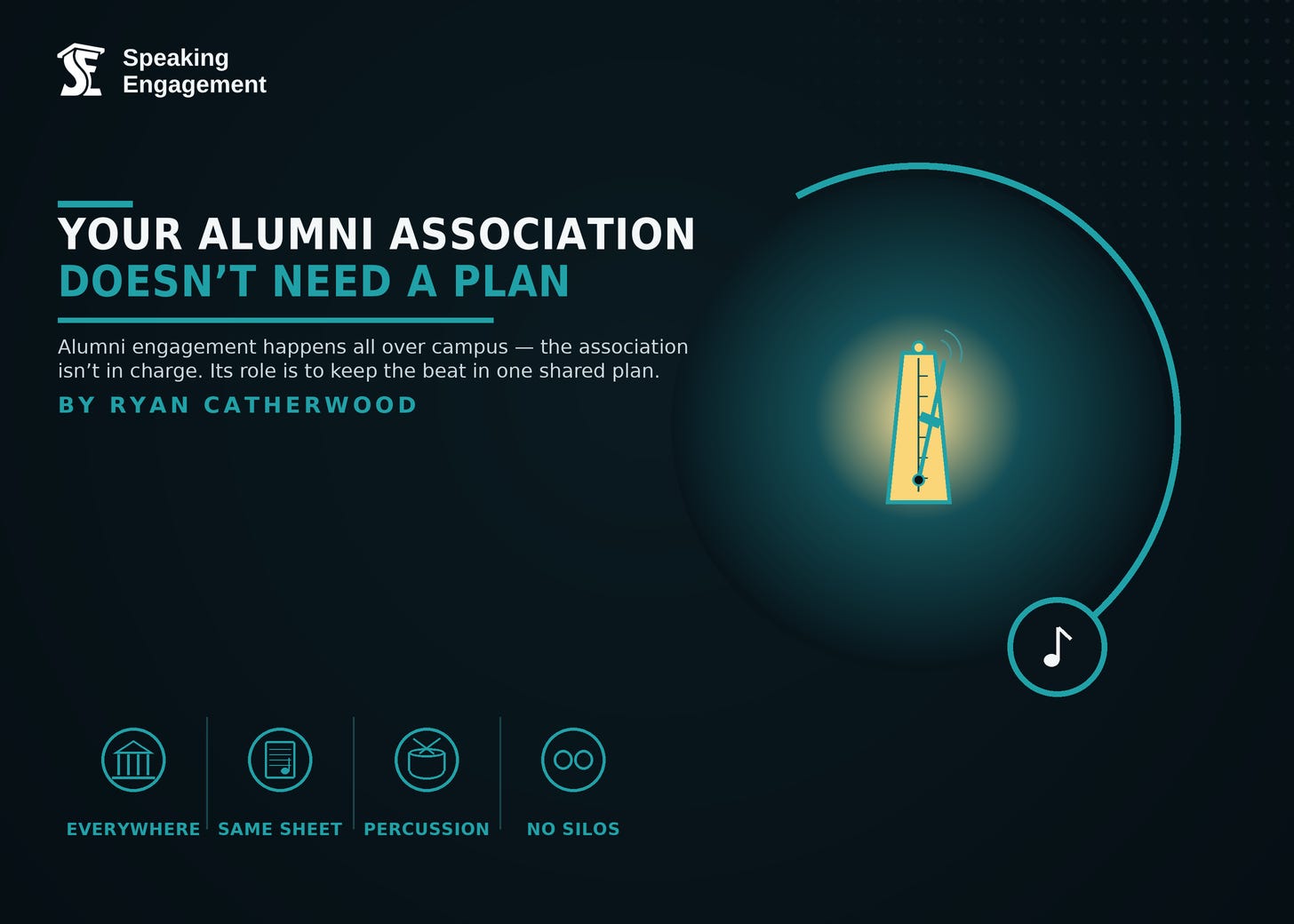
Alumni engagement is a symphony.
The analogy I use most often when conducting strategic planning workshops is to suggest that alumni engagement at any institution is a symphony. Each institution must develop its own time signature — the beats in the measure and the value of each beat. Everyone across the university needs to be playing from the same sheet of music.
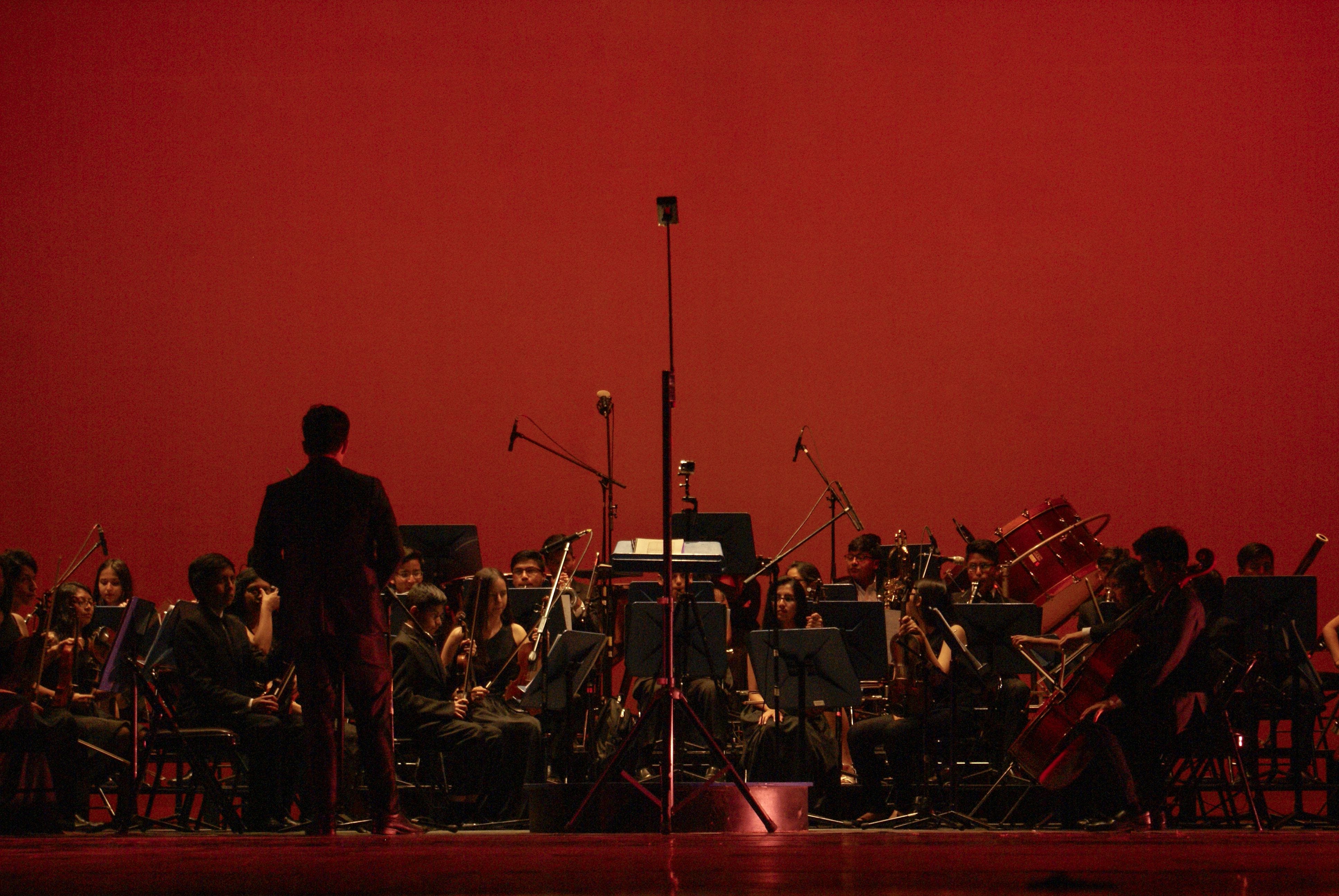
I often describe the alumni association as the percussion section of the symphony. It’s there to help by keeping the beat and to make sure the other sections of the symphony stay connected so the music sounds great. To continue the metaphor, the College of Business is then the woodwinds section, and athletics is the strings, and career services is the brass, etc. These sections often have their own soloists.
The percussion section (alumni association) is also capable of producing some incredible solos, too. Still, broadly speaking, it exists to help keep the rest of the symphony in time, with a distinct tempo and form. But when a good plan is in place, and everyone is bought in, the symphony creates beautiful music.
When it’s not, the song sounds like shit because everyone is playing over each other.
An alumni association should play a significant but ultimately supporting role in conducting enterprise-wide engagement.
Whenever I do strategic planning for alumni and constituent engagement with my CMAC clients, I work with my partners in advancement or the alumni association to bring together a task force of individuals from across the institution to help inform and build the finished plan. These are representatives from all the sections in the symphony.
The reason for this is not just because these task force members (faculty, administrators, students, and volunteers) are already engaging alumni in their day-to-day work; it’s to avoid silos and ensure everyone is playing from the same sheet of music.
So no — your alumni association doesn’t need its own strategic plan. Instead, it needs to play the most important supporting role. All educational organizations need an enterprise-wide plan for alumni engagement, and the association is the percussion section that keeps everyone in time; that’s how you get a Boston Pops-quality performance.
About Speaking Engagement
Last week, I promised a Part 2 article about the tactics for creating Unreasonable Hospitality based on Will Guidara’s book. I’ll get back to that next week.
Here’s an update on the content format and delivery method moving forward so subscribers and members can anticipate what’s arriving and on which days. I also want to be conscious of not hitting your inboxes too much.
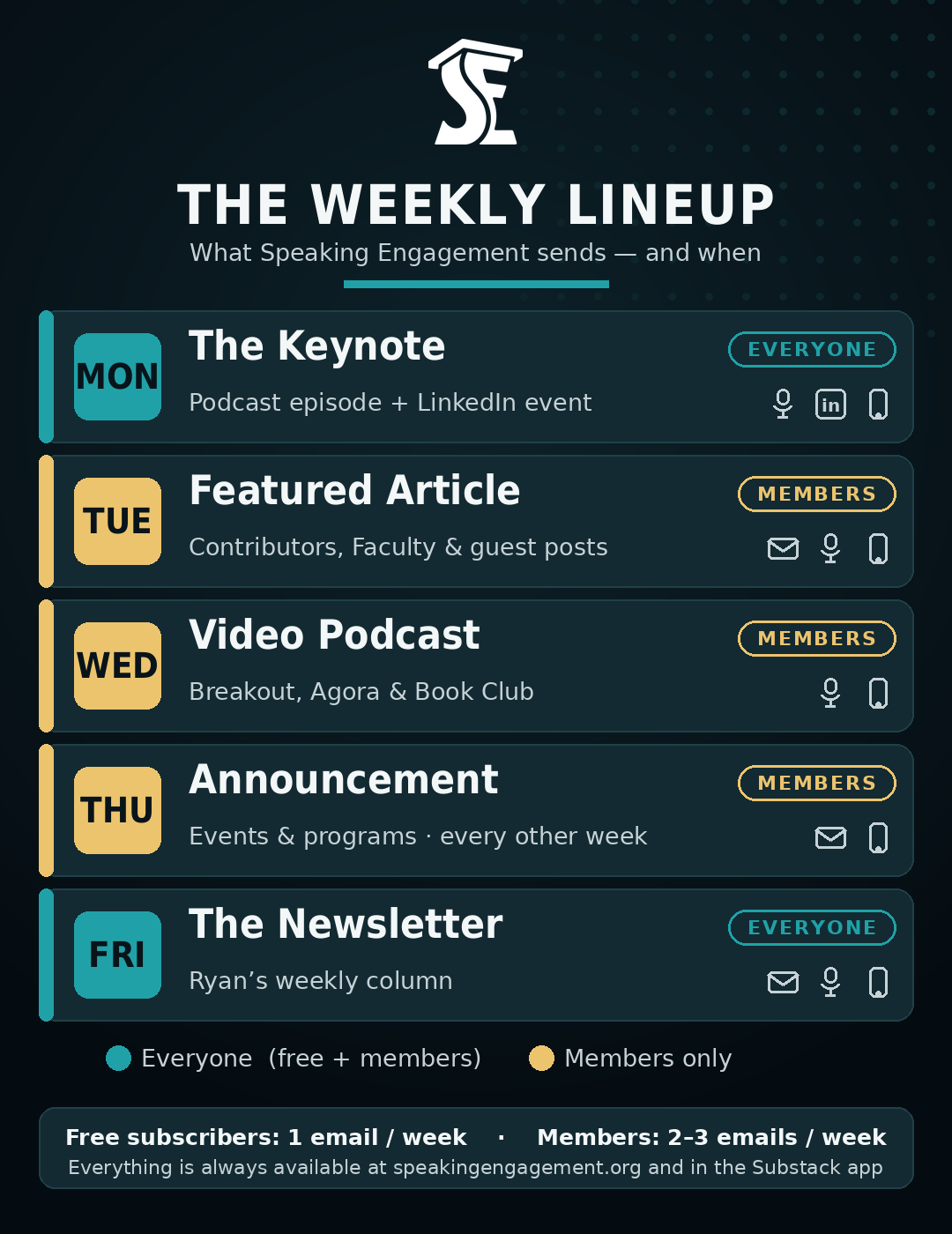
Subscribers (free) and Members (paid):
Mondays: The Keynote podcast. Starting Monday (8/17), you’ll always be able to watch or listen on LinkedIn via our SE Page, speakingengagement.org, or in the Substack app, but I’m not going to hit your inbox.
Fridays: My newsletter - delivered by email, podcast (AI-reading), and available through the app or site.
Members-only:
Tuesdays: A featured article from our Contributing Editors, our Faculty-in-Residence, or a guest post from an SE member - delivered by email newsletter, podcast, app, or site.
Wednesdays: Our additional video podcast for the week, including the Breakout, a recent Agora presentation, or an extended conversation featuring the research from our Faculty-in-Residence or Book Club commentary. This will be delivered by podcast or through the app and website.
Thursdays: Every other week, you’ll receive an announcement of an upcoming event, program, or initiative. This will be delivered as an email and available on the site or Substack app.
What this all means is that free Subscribers will receive one email from us per week, and Members will receive two emails most weeks, three on announcement weeks.
Up Next on The Keynote
We begin our Faculty-in-Residence experience by featuring Mallory Erickson on the Keynote. Mallory is our resident for the next six weeks, starting on Monday!

Mallory Erickson works at the intersection of fundraising strategy, executive coaching, and behavior design to help nonprofit professionals excel at the most human part of their job, connection. A former fundraiser turned coach, she has trained over 100,000 fundraisers. She is the creator of the Power Partners Formula™️, a framework that helps nonprofit leaders raise more from the right funders so they can move more money toward what matters most, without burning out.
She is the author of What the Fundraising and host of the podcast by the same name, where she unpacks the hidden systems that shape how fundraisers show up, from chronic stress and perfectionism to the scarcity mindset embedded in the sector’s DNA. Her work centers on the belief that when we support the people behind the purpose, we get better results and a more sustainable social impact sector.
In 2025, Mallory launched Practivated, an AI-powered fundraiser readiness platform. Readiness, the way Practivated defines it, is the combination of skills, confidence, and muscle memory, and until now, fundraisers have had almost no structured way to build it. From big asks to tough objections, Practivated gives fundraisers a safe, dynamic space to practice the conversations that matter most, building the internal capacity to show up, adapt, and connect no matter who walks in the room.
I agree with this post. The challenge is how do we go about changing this culture without damaging relationships with some of our most passionate volunteers. I think there's definitely a change management process to go through to get buy-in.
Agree completely! In a former role, I did not get overly focused on developing a formal alumni engagement strategic plan...I focused on strategic direction and ensured our programming and activities supported the institution's strategic priorities. Also love how you defined the 3 forms of alumni associations we see today.