
What can a college admissions tour reveal about creating a culture of generosity?
It’s the question I asked myself last week when I took the official admissions tour at Texas State University. I was in San Marcos to present on integrated advancement with Chris Marshall to a group of volunteers the following day, and I thought the tour would help me understand the vibe of the place. It did that. I came to appreciate the school’s history, traditions, and some of its distinctive characteristics.
I was also curious whether, and how, the word “alumni” came up during the tour, and how the university communicates about its culture of generosity that leads to philanthropy. The word “alumni” came up twice during the tour; once as a fact to describe the population of graduates, and a second time when the tour guide mentioned as a quip that “Bobcats like to hire Bobcats.”
Now, I don’t take very many admissions tours; I’ll admit. Every once in a while, as a consultant, if the timing is right and I’m on campus, I’ll ask for a campus tour. It’s often a personalized tour from an intern in the advancement office, and not the official one from admissions.
I’m not here to knock TXST because it was a perfectly enjoyable experience, the school is doing great with enrollment, and also I’m certain that the vast majority of official admissions tours are quite similar. But if a school wanted to communicate an “Alum from Day 1” message and tout a culture of generosity, there’s a lot of experience design to rethink and implement.
The first step in building a culture of generosity would be to ensure that, at specific stops on the tour, an alum is present and can speak to what the school gave them and the values that matter.
Imagine an admissions tour where the guide serves as more of a chaperone. Instead of the guide delivering most of the talk tracks at different stops, graduates with different backgrounds are stationed throughout the tour, sharing their experience from the perspective of someone who’s lived it and can confidently tout the results. They ARE the result.
At every institution, hundreds of alumni often work there in roles across faculty and staff. The message about value could be delivered in multiple ways. Not only can the alum employee recommend the experience as a former student, but they can also explain why the school matters enough that they chose to work there.
A next step is to create an experience where prospective students and their families see signage with messages of praise, advice, and congratulations from alumni directed at students.
Now imagine a moment on an admissions tour when prospective students and their families walk past a giant wall in the student center or library covered with handwritten posters from alumni volunteers wishing students well for the new semester. Think of the rhetorical significance of a moment like that and how it would be remembered.
Here, you have clear evidence that the alumni community supports students throughout their journey at the institution. They are present both in body and in spirit, en masse.
In addition, display flags or banners across campus featuring successful alumni and their stories of achievement. I’m not talking about just the CEOs and those who are wealthy enough to have their names on buildings. There are tons of alumni innovators doing amazing work in their communities or field of professional practice.
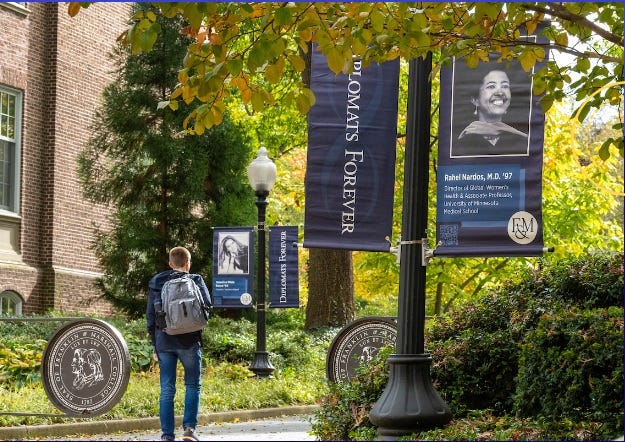
I often think of the Diplomats Forever banner program at Franklin & Marshall College, where a series of banners hang throughout campus. To create a true “Alumni from Day 1” mentality that isn’t just a slogan but real life, students must see these messages day in and day out about their graduates making an impact in their workplace, communities, and on campus as volunteers.
Creating a culture of generosity starts with telling the stories of lifelong involvement not just on the admissions tour, but by making these individuals and their stories visible every day.
The signs and messages are powerful because they create a sense of Alumni Identity (we’ll talk more about this with Jay Dillon beginning next week) from the very beginning of a student’s interactions with their college or university. Students and their families understand that graduates play an outsized role in supporting the school. Alumni aren’t people who graduate and go away. They’re still present, and they continue to pay it forward because they’re every bit a part of the community, just like those who are enrolled.
Educational institutions must make a not-so-difficult decision: focus on experience design through the lens of what communicates lifelong involvement. You can’t create a culture of philanthropy without first dedicating time and resources to communicating “alumni-ness.” It’s not just about emails and social posts, either. The campus and its walls, pathways, and lampposts must be carefully utilized to deliver this critical message.
I encourage everyone reading this to take the official admissions tour at your school and ask yourself, “What does this reveal about our culture of generosity?” My guess is the only sign you’ll find is the names on buildings (unless you happen to take the tour around a giving day). And names on buildings communicate a kind of wealth so far out of reach for pretty much everyone. It puts generosity out of reach, but it shouldn’t. Instead, generosity and Alumni Identity should start with more accessible narratives that show how alumni are truly valued and that people like them actually do it.
Building a culture of generosity and investment begins on the admissions tour but it’s not just for the prospective students. Colleges and universities need to reinforce this message in an ongoing way to ensure that the message is clear: generosity thrives here because we’re kind to each other, we’re proud of one another, and we love to show it.
About Speaking Engagement
One of the most interesting aspects of leading Speaking Engagement is looking at the actual engagement data for the content we’re producing. I’ll admit that I’ve been surprised by the overall lack of activity. Very few people in our community are commenting, sharing, or even hitting the like button on the content, even though people are reading and listening.
Richard Millington is a recent Keynote speaker on SE and an expert in community-building. He recently posted on LinkedIn that community engagement is down 50% overall. That’s a lot!
It’s interesting to think about why that might be. Maybe we’re too busy. Perhaps there’s just too much content out there, and we’re consuming it so fast. At the end of the day, I want SE to be valuable, and your comments and the Contributors team have reflected that. If folks still feel SE is worth the attention without all the comments and discussion, I’m good with that, but please do consider sharing Speaking Engagement with your peers and colleagues around higher ed to help get the word out.
About the Next Keynote
On Monday, we launch our next Faculty-in-Residence with Dr. Jay Dillon on the Keynote podcast. This was a really fun convo with someone I’ve known for a decade or more. Jay is part of my podcasting origin story, having been willing to let me interview him for the Advancement Legends podcast I produced years ago.
We dig into his research on Alumni Identity on the pod, and we’ll get even deeper in the weeds on why it’s so important over the next few weeks. You might even find a few of his takes controversial. Jay is a leader and a disruptor in our space, and I really value that about him. Lots coming!


